
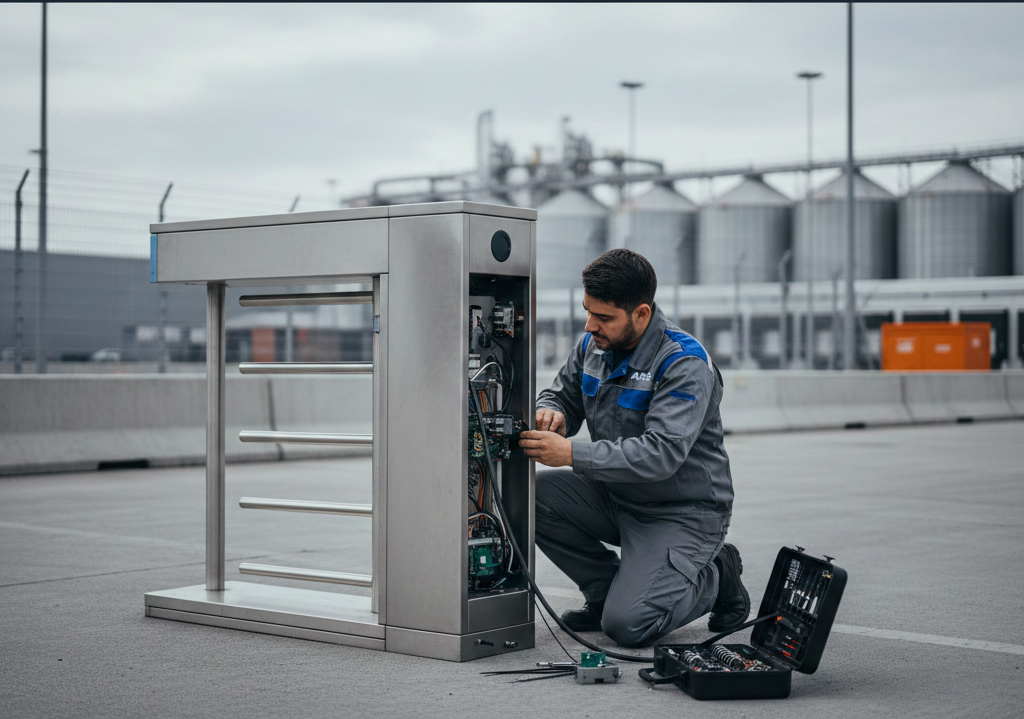
3 MacGyver Fixes for Broken Turnstiles Using R200 Parts
It’s 06:45 on a Monday morning. Your pedestrian turnstile at the main gate has just stopped releasing, and there’s a queue of thirty increasingly agitated staff members forming outside. The contracted technician can’t come until Wednesday. Your facilities manager is looking at you with the expression of someone who’s about to have a very long day. This is not how anyone planned to start the week.
If you’ve worked in security or facilities management for more than a month, you know this scenario intimately. Turnstiles fail. They fail at precisely the wrong moment, and they fail in ways that require parts you don’t have or technicians who are somewhere else entirely. While we always advocate for proper maintenance contracts and genuine replacement parts, the reality is that sometimes you need to keep things operational until the cavalry arrives.
That’s where the R200 fix comes in.
What Are “R200 Parts”?
We’re talking about the kind of components you can pick up at your local hardware store or electrical supplier without breaking the budget or waiting for international shipping. Springs, cable ties, basic fasteners, wire offcuts, rubber washers, spray lubricants. The unglamorous bits that live in workshop drawers and have saved more installations than any marketing department would care to admit.
These aren’t permanent solutions. They’re tactical workarounds that keep your access control functioning while you wait for the correct replacement parts or qualified service personnel. Think of them as the security equivalent of a spare tyre—you’re not doing the Dakar Rally on it, but it’ll get you home.
Fix #1: The Seized Solenoid Spring
The Problem: Your turnstile’s drop-arm mechanism isn’t releasing. You can hear the solenoid clicking when a valid card is presented, but the arm stays firmly locked. The usual culprit is a failed or weakened return spring in the solenoid assembly, often corroded or stretched beyond usefulness after years of coastal humidity or simple wear.
The Parts (R150):
- One compression spring from the hardware store (approximately R50–80, depending on size)
- Cable ties (pack of 50 for about R30)
- A small tube of marine grease or lithium grease (R40)
The Logic: Most turnstile drop-arm solenoids use a simple spring-return mechanism. When energised, the solenoid retracts against spring tension. When power cuts, the spring should push the plunger back to the locked position. If that spring has weakened or broken, the solenoid clicks but nothing moves. You’re replacing the spring tension with a hardware store equivalent.
Open the solenoid housing (power off first, obviously). Remove the failed spring. Measure it. Visit your hardware store and find the closest compression spring match—slightly stiffer is better than weaker. Install it in place of the original. If the new spring is marginally too long or short, use cable ties or washers as spacers to achieve the correct tension. Apply a small amount of grease to the plunger shaft to reduce friction.
Caveats: This works for mechanical spring failures in relatively standard solenoid assemblies. It doesn’t fix electrical failures, burnt coils, or complex electronic locking mechanisms. If your solenoid isn’t making any sound at all, this fix won’t help. Also, ensure the replacement spring’s dimensions are reasonably close—a spring with wildly different compression characteristics may cause erratic locking or failure to release under load. Test thoroughly before putting it back into service.
Fix #2: The Phantom Read Problem
The Problem: Your turnstile is registering phantom reads—granting access when no card is presented, or worse, locking up because it thinks a card is permanently in the reader field. This is often caused by damaged or corroded wiring between the card reader and the controller, or a loose connection that’s intermittently making contact.
The Parts (R120):
- Electrical tape (R15)
- A small tube of petroleum jelly or dielectric grease (R35)
- Heat-shrink tubing assortment or additional cable ties (R30)
- Spare 4- or 6-core alarm cable offcut (often free from your stores, or R40 per metre)
The Logic: Access control readers communicate with controllers via low-voltage signal wiring. When these connections corrode or fray—especially in outdoor installations—you get intermittent signals that the controller interprets as reads. The fix is straightforward: inspect every connection point between reader and controller, clean corrosion with a wire brush or fine sandpaper, apply dielectric grease to protect against moisture ingress, and secure connections properly.
If you find a damaged cable section (common where cables pass through metal conduit or are exposed to movement), cut out the damaged portion and splice in a short replacement section using terminal blocks or solder joints, then insulate thoroughly with heat-shrink or electrical tape. Secure the entire run with cable ties to prevent future movement damage.
Caveats: This is a field repair for physical wiring issues only. If your reader has failed internally or the controller board is damaged, new wiring won’t solve anything. Don’t attempt this fix if you’re not confident working with low-voltage systems—incorrect terminations can cause more problems than they solve. And remember that poorly executed splices can introduce new points of failure. When in doubt, run a completely new cable.
Fix #3: The Loose Arm Rattle
The Problem: The turnstile arm has developed excessive play in its mounting bracket. It rattles, doesn’t align correctly with the locking mechanism, and occasionally fails to engage properly. This usually results from worn bushings or loosened mounting hardware after thousands of rotation cycles.
The Parts (R80):
- Rubber or nylon washers assortment (R30)
- Threadlock compound (small bottle, R40)
- Replacement mounting bolts if originals are worn (R10)
The Logic: Turnstile arms pivot on a central shaft with bushings or bearings that wear over time, especially if maintenance intervals have been… optimistic. The play allows the arm to sit at slightly wrong angles, which prevents clean engagement with the locking pawl or drop-arm. By adding appropriately sized washers at the mounting points, you can take up the slack and restore proper alignment.
Remove the arm (mark its position first). Inspect the mounting shaft and bushings for wear. Clean everything thoroughly. Add washers on either side of the bushing to eliminate lateral play—you want the arm to rotate freely but without wobble. Reassemble, ensuring mounting bolts are torqued correctly. Apply threadlock to prevent them backing out again. Test rotation through full range of motion before reconnecting to the locking mechanism.
Caveats: This fix addresses wear and looseness, not catastrophic bearing failure or bent shafts. If the arm’s mounting shaft is visibly damaged or the housing is cracked, washers won’t help—you need replacement parts. Over-tightening to compensate for wear will cause binding and motor strain. The goal is to eliminate play while maintaining smooth rotation. If you can’t achieve both, stop and call a technician.
The Safety Disclaimer (Because Lawyers Exist)
Let’s be absolutely clear: these are temporary measures to maintain operational capability until proper repairs can be completed. They are not substitutes for genuine manufacturer parts, qualified technicians, or regular maintenance schedules. If your fix doesn’t work immediately or creates new problems, stop and reassess. Never implement a workaround that compromises site security or creates safety hazards for users. Document everything you do, inform your maintenance contractor, and get proper repairs scheduled as soon as possible.
None of these fixes should remain in place permanently. They buy you time. Use that time wisely.
The Takeaway: Resilience Is a Mindset
The best security professionals aren’t the ones who never encounter problems—they’re the ones who can think clearly when problems arrive. Knowing your equipment inside out, maintaining a modest stock of generic spares, and understanding basic mechanical and electrical principles makes you valuable in ways that no certification alone can achieve.
Keep a basic toolkit near your access control points. Stock cable ties, electrical tape, springs, and fasteners. Know who your local suppliers are and what they carry. When something breaks at 06:45 on a Monday, you’ll be the person who solves the problem rather than the one explaining why it can’t be solved.
That’s worth considerably more than R200.
Good a blog toper
Hahahaha You are so good
Enjoy every single day
https://shorturl.fm/U5r6N
Yo, I gave 9377wingame a spin. It’s got its own thing going on. If you’re tired of the same old stuff, you could find something interesting here. No harm in looking, right? Check it out!. Fly to 9377wingame, to win!
Downloaded the z777gameapk earlier today. Installation took no time, and the app runs super smooth. I’m quite impressed. Recommended if you are looking for a new game app! z777gameapk
Yo, CK999game is pretty dope! A good selection of games and it’s easy to find what you’re looking for. What are you waiting for? ck999game